05. Soil & Atmosphere
What you will learn
What MARMIT, BSM, SMAC, and SPART each simulate.
How soil moisture changes a soil reflectance spectrum, and how much that matters relative to the canopy above it.
Why top-of-canopy (TOC) and top-of-atmosphere (TOA) reflectance diverge sharply at specific wavelengths.
Concept
Two independent soil models feed two different canopy/atmosphere chains:
Model |
What it represents |
Used by |
|---|---|---|
MARMIT |
Starts from a real dry reference soil spectrum and adds a physically modelled liquid-water film, so the same soil can be simulated at any moisture level. |
Standalone, or as |
BSM (Brightness-Shape-Moisture) |
Builds a soil spectrum from three empirical parameters
( |
Built into |
SMAC |
Atmospheric radiative transfer (gas absorption + aerosol scattering) converting TOC reflectance into what a sensor measures above the atmosphere. |
Built into |
SPART |
The full chain: BSM soil -> fourSAIL canopy -> SMAC atmosphere -> TOA reflectance, already resampled to a real sensor’s bands. |
Python tools used
Function |
Key arguments |
|---|---|
|
|
Trait dict (leaf + canopy + atmosphere: |
Run the example
from toolsrtm import get_marmit_rsoil, spart_toa, sentinel2a_msi

# 1. MARMIT: dry -> wet soil spectrum
soil = get_marmit_rsoil(soil_id=3, L=0.05, eps=0.4, version="marmit1")
print("Soil moisture content:", float(soil.smc))
for wl in (550, 850, 1600):
    i = wl - 400
    print(f"{wl}nm: dry={soil.rsoil_dry[i]:.4f}  wet={soil.rsoil_wet[i]:.4f}")

# 2. SPART: BSM soil -> fourSAIL canopy -> SMAC atmosphere -> TOA
result = spart_toa(
    dict(N=1.5, Cab=40, Car=8, Anth=1, Cbrown=0, EWT=0.01, LMA=0.009, alpha=40,
         Prot=0.002, CBC=0.007, LIDFa=-0.35, LIDFb=-0.15, TypeLidf=1,
         LAI=3, hspot=0.01, tts=30, tto=0, psi=0,
         Pa=1000, aot550=0.3246, uo3=0.348, uh2o=1.4116),
    sensor=sentinel2a_msi(), leaf_model="PROSPECT-PRO",
    BSMBrightness=0.5, BSMlat=25, BSMlon=45, SMp=15,
)
print("Sentinel-2A bands (nm):", result.wl_smac)
print("TOC:", result.rfl_toc_brdf.round(4))
print("TOA:", result.rfl_toa.round(4))
Result
Printed output (exact, deterministic):
Soil moisture content: 39.900691712115204
550nm: dry=0.1316  wet=0.1064
850nm: dry=0.2608  wet=0.2151
1600nm: dry=0.4758  wet=0.3178
Sentinel-2A bands (nm): [ 445.  520.  560.  654.  701.  743.  779.  789.  871.  942. 1372. 1639. 2256.]
TOC: [0.0159 0.0414 0.0556 0.0238 0.0662 0.3305 0.4021 0.4032 0.4064 0.4029 0.2806 0.2248 0.0805]
TOA: [0.1182 0.1057 0.0899 0.0488 0.0803 0.3104 0.3846 0.3679 0.3904 0.1215 0.0022 0.2091 0.0736]
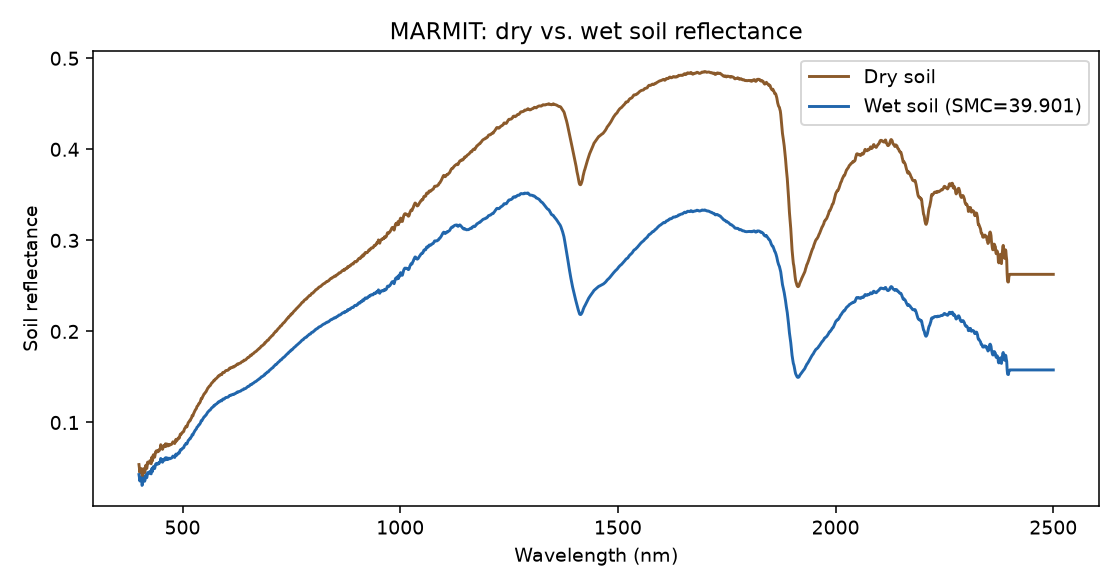
Real output: MARMIT’s dry-reference vs. wetted soil reflectance – the SWIR water-absorption dips (~1400/1900nm) deepen and overall brightness drops as the soil wets.
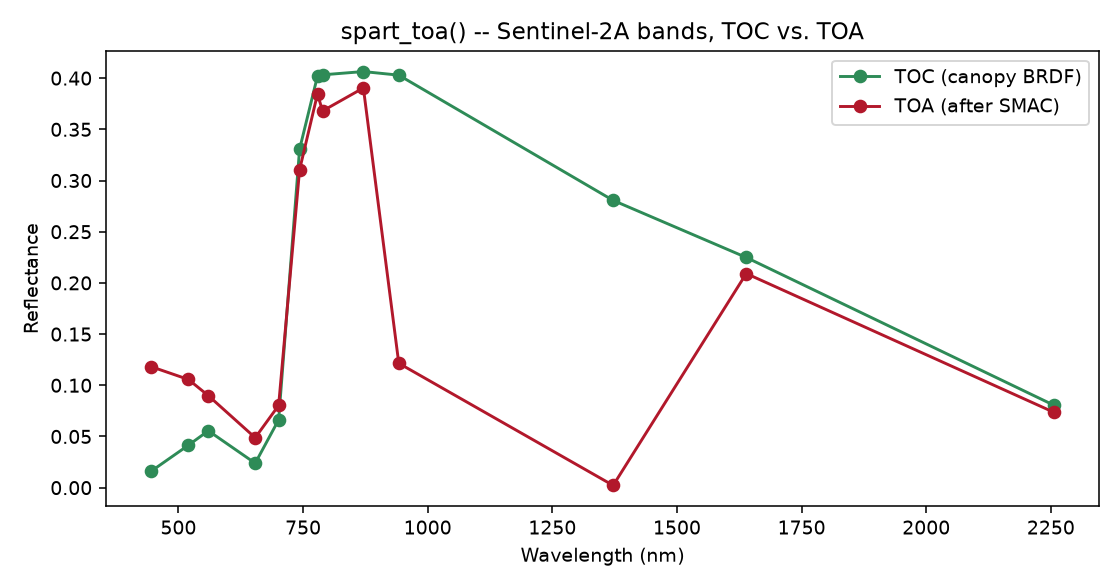
Real output: TOC and TOA reflectance diverge sharply in the water-vapour bands (~940/1370nm), where the atmosphere absorbs most of the signal before it reaches the sensor.
Interpretation
Wetting the soil (MARMIT) lowers reflectance everywhere, but not by an
equal fraction: at 1600nm (a SWIR water-absorption region) the drop is
large (0.476 -> 0.318, -33%), while at 550nm (visible) it’s smaller
(0.132 -> 0.106, -19%) – soil moisture leaves its strongest fingerprint
in the SWIR, the same spectral region leaf equivalent-water-thickness
(EWT, 02. Parameters & Traits) affects, for the same physical
reason (liquid water absorbs strongly there).
The TOC-vs-TOA comparison from SPART tells a different, atmosphere-driven story: at most bands TOC and TOA are reasonably close (e.g. 779nm: 0.403 vs. 0.385), but at the two bands SPART itself sits on real water-vapour absorption features (942nm, 1372nm), the atmosphere removes most of the signal before it reaches “space” – TOC 0.403 collapses to TOA 0.122 at 942nm, and TOC 0.281 collapses to a near-zero 0.002 at 1372nm. This is exactly why real sensors either avoid placing bands there (Sentinel-2’s narrow B9/B10 bands specifically target these features for atmospheric correction, not surface retrieval) or need real atmospheric correction before the data is usable for vegetation analysis.
Try it yourself
Raise
L(MARMIT) from 0.05 to 0.15 (much wetter) and see how much further the SWIR dips deepen.Change
aot550(aerosol optical thickness) from 0.32 to 0.05 (clear sky) and compare how much the visible-band TOA values shift – aerosol scattering matters most in the blue/visible, not the SWIR.Feed MARMIT’s
soil.rsoil_wetdirectly asrsoilinto 04. Canopy Radiative Transfer Models’sfoursail()call, and compare the resulting TOC reflectance against the flatrsoil=0.15baseline used there.
Common mistakes
MARMIT and BSM are two independent soil models –
spart_toaalways uses BSM internally (BSMBrightness/BSMlat/BSMlon/SMp), not whatever MARMIT spectrum you may have built separately.spart_toareturns one value per sensor band (13 for Sentinel-2A), not the full 2101-element native spectrum –rfl_toc_brdf/rfl_toaare already resampled.Atmospheric water-vapour bands can swing from a plausible reflectance value at TOC to near-zero at TOA – a real atmospheric effect, not a sign the simulation broke.
Next
06. SCOPE – SCOPE, the ecosystem-scale model that replaces the “soil brightness + fixed temperature” shortcuts above with a real coupled energy balance.
Using R? -> ToolsRTM Tutorial 03: SPART and Tutorial 16: MARMIT + fourSAIL + SPART