ToolsRTM package



-181717?logo=github&logoColor=white)
The ToolsRTM package provides a comprehensive suite of tools for simulating canopy reflectance using various radiative transfer (RT) models at multiple satellite resolutions. Currently in the testing phase, this package is designed to facilitate detailed simulations, enabling versatile and accurate analyses of canopy reflectance characteristics.
ToolsRTM documentation — A Package for Simulating RT Models
For canopy-level simulations, the package features models such as INFORM, fourSAIL, and fourSAIL2. When it comes to leaf-level simulations, it includes the PROSPECT model (with D and PRO variants), Liberty, and FLUSPECT (B-Cx). These models empower users to conduct sophisticated simulations that capture the intricate dynamics of reflectance behavior in both leaf and canopy contexts.
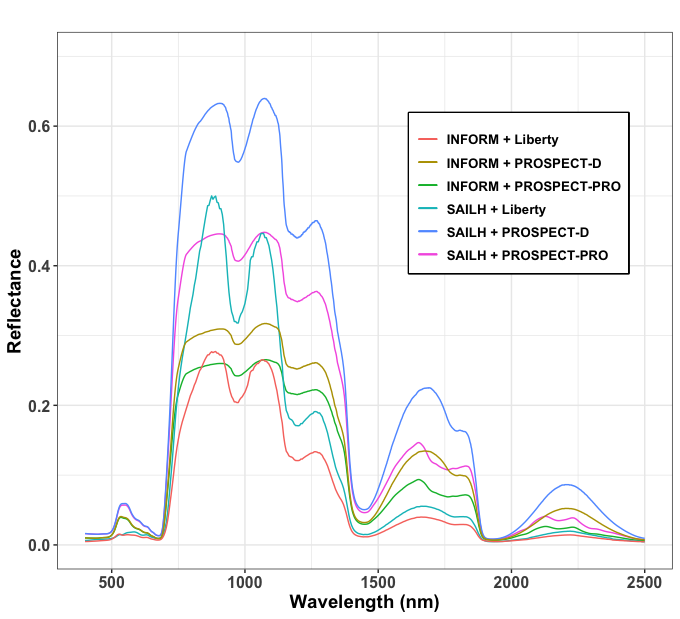
Fig. 1. Simulations performed with ToolsRTM Package for several radiative transfer models .
Additionally, the SPART model (Soil-Plant-Atmosphere Radiative Transfer model) is tailored for satellite measurements in the solar spectrum. It integrates three computationally efficient RT models: the BSM model for soil, PROSAIL for vegetation canopies, and SMAC for the atmosphere. These components are interconnected using the four-stream theory and the adding method, allowing SPART to simulate directional top-of-atmosphere (TOA) spectral observations. This approach accounts for significant effects, such as sun-observer geometries and the non-Lambertian reflectance of the land surface.
ToolsRTM includes MARMIT (Multilayer rAdiative tRansfer Model of soIl reflecTance), a radiative transfer model for simulating the spectral reflectance of bare soil as a function of surface water content. MARMIT simulates soil reflectance across the 400–2500 nm spectral range at 1 nm resolution. The high-level get.marmit.rsoil() wrapper, built on get.marmit1() and get.marmit2(), loads a dry-soil reference spectrum and runs the MARMIT simulation directly.
The package includes the Bablet 2016 soil database by default to keep the installation lightweight. Seven additional MARMIT soil databases are available in the RTM-Suite databases/ directory:
- Dupiau 2020
- Humper 2015
- Lesaignoux 2008
- Liu 2002
- Lobell 2002
- Marcq 2012
- Philpot 2014
Together, these databases represent approximately 200 MB of additional soil spectral data. They can be used directly with get.marmit.rsoil() by specifying their location through the db_root argument, without copying the files into the R package.
soil <- ToolsRTM::get.marmit.rsoil(database = "Liu_2002", id = 1, db_root = "databases")RTM-Suite: A Unified R and Python Framework
ToolsRTM is one library within RTM-Suite, which links both the R packages (ToolsRTM, SCOPEinR) and their Python ports (toolsrtm, scopeinpython) behind one common site — with reference manuals, worked tutorials, and runnable example pipelines for both languages side by side.
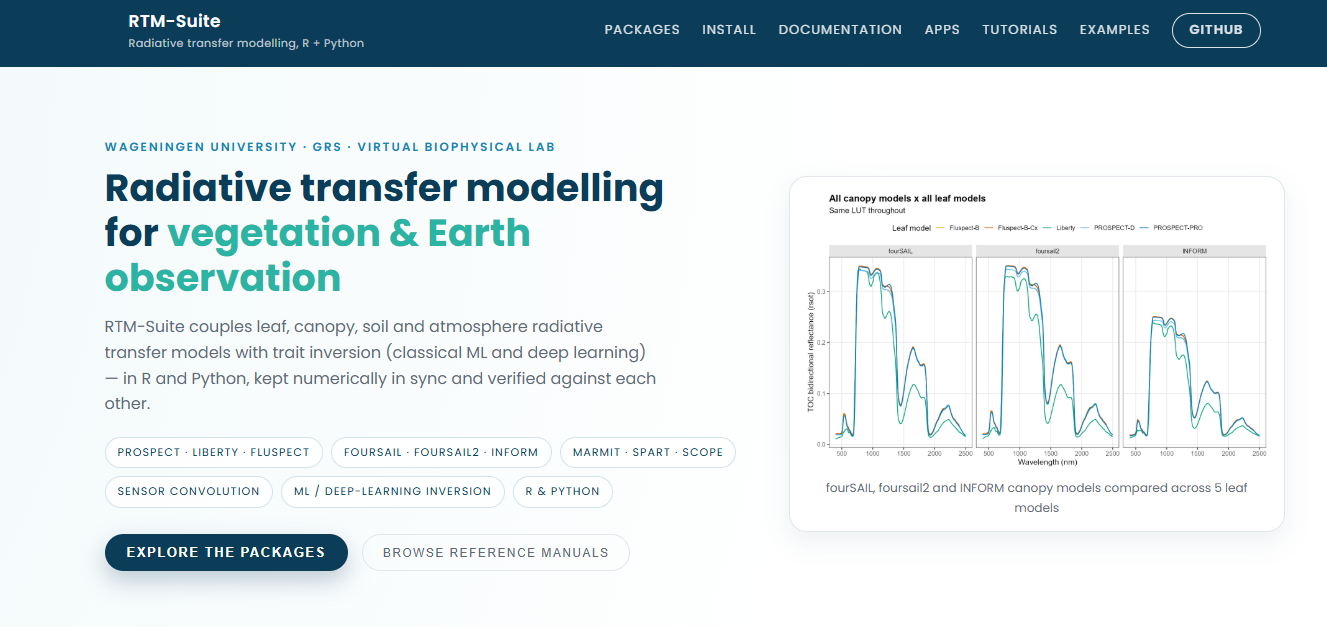
Fig. 2. The RTM-Suite website — see Documentation for R/Python reference manuals, Tutorials for step-by-step walkthroughs (R and Python side by side), and Examples for copy-paste runnable code with real generated figures.
Installation in R
ToolsRTM requires R 4.3 or newer. Install the development version directly from GitLab:
if (!requireNamespace("remotes", quietly = TRUE)) {
  install.packages("remotes")
}

if (!requireNamespace("ToolsRTM", quietly = TRUE)) {
  remotes::install_gitlab("caminoccg/toolsrtm", upgrade = "never")
}
Alternatively, install a downloaded source archive:
install.packages(
  "path/to/toolsrtm-main.tar.gz",
  repos = NULL,
  type = "source"
)
Check the installed version:
packageVersion("ToolsRTM")The version described by this README is 0.62.5.
Quick example
The following example creates a small lookup table and runs PROSPECT-PRO coupled to fourSAIL. Both getLUT() and simulate_RTM() are exported by the current package.
inputs <- ToolsRTM::inputsPROSAIL
lut <- as.data.frame(
  ToolsRTM::getLUT(inputs = inputs, nLUT = 30, setseed = 1234)
)
rsoil <- rep(0.2, 2101)

simulation <- ToolsRTM::simulate_RTM(
  inputLUT = lut[1, , drop = FALSE],
  rsoil = rsoil,
  leaf.model = "PROSPECT-PRO",
  canopy.model = "fourSAIL"
)
SCOPEinR
Install SCOPEinR when the workflow requires the SCOPE model. ToolsRTM is installed first because SCOPEinR imports it.
if (!requireNamespace("remotes", quietly = TRUE)) {
  install.packages("remotes")
}

remotes::install_gitlab("caminoccg/toolsrtm", upgrade = "never")
remotes::install_gitlab("caminoccg/scopeinr", upgrade = "never")
packageVersion("SCOPEinR")
For an offline installation, replace the second install_gitlab() call with:
install.packages(
  "path/to/scopeinr-main.tar.gz",
  repos = NULL,
  type = "source"
)
Manuals and RTM-Suite resources
| Resource | Description |
|---|---|
| RTM-Suite documentation | Entry point for the complete R suite |
| ToolsRTM reference | Function reference and package articles |
| Tutorials 01-18 | The full numbered tutorial series: leaf/canopy RT, SPART, model comparison, LUTs, parallel simulation, hyperspectral sensors, indices, sensitivity, hybrid/ML/DL inversion, end-to-end pipeline, real Sentinel-2 (STAC) applications, MARMIT+SPART soil integration, and a forest time-series capstone |
| Real EO application | Real Sentinel-2 retrieval (STAC) and a genuine spatial trait map |
| Reference manuals | The older comprehensive ToolsRTM/Getting-LUTs/InversionOpt manuals, kept alongside the tutorial series |
| SCOPEinR reference | SCOPE model documentation |
| SCOPEinR tutorials 01-11 | Energy balance, fluorescence, hybrid inversion, and a real-Sentinel-2 photosynthesis capstone |
| Tutorials | Reproducible R tutorials included in RTM-Suite |
| Pipeline scripts | Adaptable simulate-to-invert workflows |
Interactive application
Use Apps/RTMs (run locally via shiny::runApp("Apps/RTMs")) to configure models and inspect simulations interactively, no code required. Its source lives alongside the rest of RTM-Suite; the Shiny application is not launched through the core ToolsRTM API.
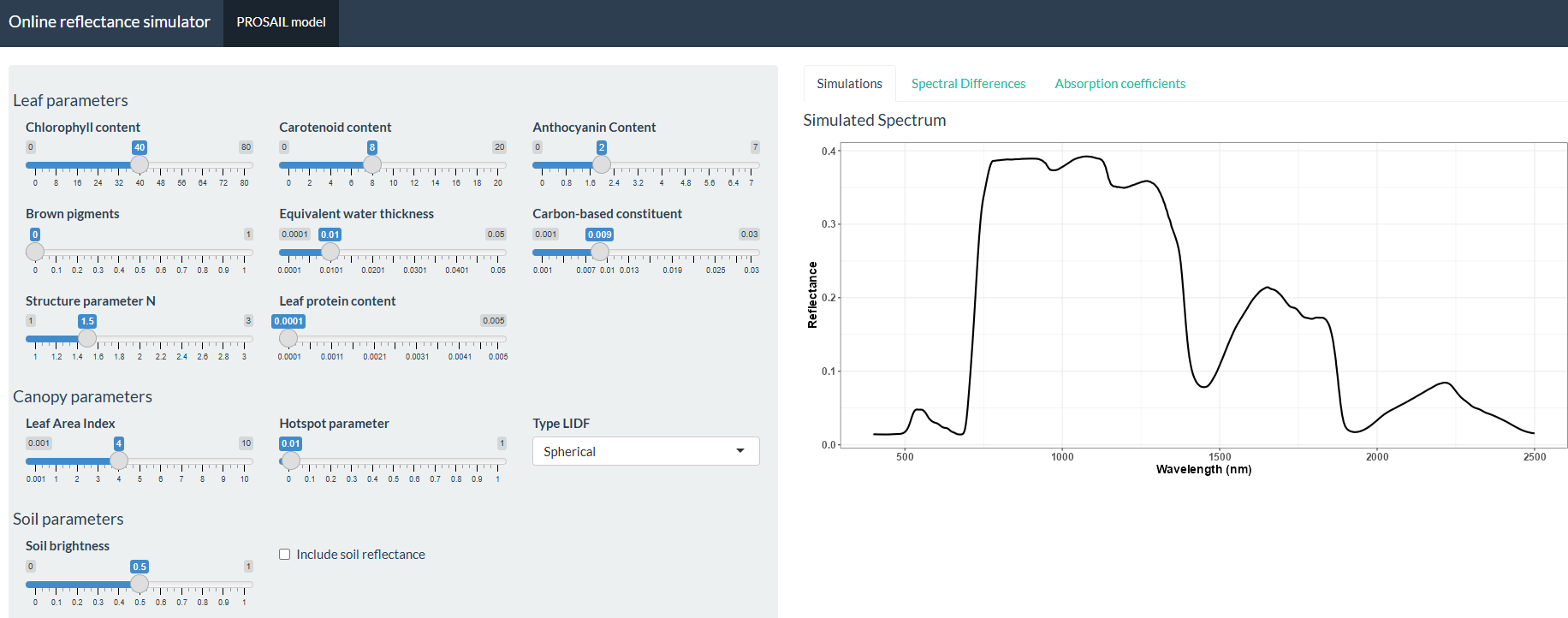
Fig. 3. Interactive reflectance simulator using PROSAIL model based on shiny app.
Citation
If you use ToolsRTM or SCOPEinR, please consider citing:
Camino et al. (2024). RT-Simulator: An Online Platform to Simulate Canopy Reflectance from Biochemical and Structural Plant Properties Using Radiative Transfer Models. IGARSS 2024, Athens, Greece, pp. 2811-2814. doi: 10.1109/IGARSS53475.2024.10642442
Arano et al. (2024). Enhancing Chlorophyll Content Estimation with Sentinel-2 Imagery: A Fusion of Deep Learning and Biophysical Models. IGARSS 2024, Athens, Greece, pp. 4486-4489. doi: 10.1109/IGARSS53475.2024.10641613
Camino et al. (in preparation). Integrating Physiological Plant Traits with Sentinel-2 Imagery for Monitoring Gross Primary Production and Detecting Forest Disturbances.
References
Leaf models
Jacquemoud, S., Baret, F. (1990). PROSPECT: A model of leaf optical properties spectra. Remote Sensing of Environment, 34(2), 75-91. 10.1016/0034-4257(90)90100-Z
Féret, J.-B. et al. (2017). PROSPECT-D: Towards modeling leaf optical properties through a complete lifecycle. Remote Sensing of Environment, 193, 204-215. 10.1016/j.rse.2017.03.004 (PROSPECT-D, adds anthocyanins)
Féret, J.-B. et al. (2021). PROSPECT-PRO for estimating content of nitrogen-containing leaf proteins and other carbon-based constituents. Remote Sensing of Environment, 252, 112173. 10.1016/j.rse.2020.112173 (PROSPECT-PRO, splits dry matter into protein + carbon-based constituents)
Dawson, T.P., Curran, P.J., Plummer, S.E. (1998). LIBERTY — Modelling the effects of leaf biochemical concentration on reflectance spectra. Remote Sensing of Environment, 65(1), 50-60. 10.1016/S0034-4257(98)00007-8
Vilfan, N., van der Tol, C., Muller, O., Rascher, U., Verhoef, W. (2016). Fluspect-B: A model for leaf fluorescence, reflectance and transmittance spectra. Remote Sensing of Environment, 186, 596-615. 10.1016/j.rse.2016.09.017
Vilfan, N., Van der Tol, C., Yang, P., Wyber, R., Malenovský, Z., Robinson, S.A., Verhoef, W. (2018). Extending Fluspect to simulate xanthophyll driven leaf reflectance dynamics. Remote Sensing of Environment, 211, 345-356. 10.1016/j.rse.2018.04.012 (Fluspect-B-Cx, adds the xanthophyll/Cx de-epoxidation state)
Canopy models
Verhoef, W. (1984). Light scattering by leaf layers with application to canopy reflectance modeling: The SAIL model. Remote Sensing of Environment, 16(2), 125-141. 10.1016/0034-4257(84)90057-9
Verhoef, W. (1998). Theory of radiative transfer models applied in optical remote sensing of vegetation canopies. PhD thesis, Wageningen University. (4SAIL, the extended/corrected SAIL version this suite’s
fourSAILimplements)Verhoef, W., Bach, H. (2007). Coupled soil-leaf-canopy and atmosphere radiative transfer modeling to simulate hyperspectral multi-angular surface reflectance and TOA radiance data. Remote Sensing of Environment, 109, 166-182. 10.1016/j.rse.2006.12.013 (introduces 4SAIL2, this suite’s
fourSAIL2)Atzberger, C. (2000). Development of an invertible forest reflectance model: The INFOR-model. In: A Decade of Trans-European Remote Sensing Cooperation, Proceedings of the 20th EARSeL Symposium, Dresden, Germany, 39-44. (no DOI, conference proceedings)
Soil, atmosphere & SCOPE
Bablet, A., Vu, P.V.H., Jacquemoud, S., Viallefont-Robinet, F., Fabre, S., Briottet, X., Sadeghi, M., Whiting, M.L., Baret, F., Tian, J. (2018). MARMIT: a multilayer radiative transfer model of soil reflectance to estimate surface soil moisture content in the solar domain (400-2500 nm). Remote Sensing of Environment, 217:1-17. 10.1016/j.rse.2018.07.031
Dupiau, A., Jacquemoud, S., Briottet, X., Fabre, S., Viallefont-Robinet, F., Philpot, W., Di Biagio, C., Hébert, H., Formenti, P. (2022). MARMIT-2: an improved version of the MARMIT model to predict soil reflectance as a function of surface water content in the solar domain. Remote Sensing of Environment, 272:112951. 10.1016/j.rse.2022.112951
Rahman, H., Dedieu, G. (1994). SMAC: a simplified method for the atmospheric correction of satellite measurements in the solar spectrum. International Journal of Remote Sensing, 15(1), 123-143.
Yang, P., van der Tol, C., Yin, T., Verhoef, W. (2020). The SPART model: A soil-plant-atmosphere radiative transfer model for satellite measurements in the solar spectrum. Remote Sensing of Environment, 247, 111870. 10.1016/j.rse.2020.111870
Van der Tol, C., Verhoef, W., Timmermans, J., Verhoef, A., Su, Z. (2009). An integrated model of soil-canopy spectral radiances, photosynthesis, fluorescence, temperature and energy balance. Biogeosciences 6(12), 3109-29. 10.5194/bg-6-3109-2009
Yang, P., Prikaziuk, E., Verhoef, W., van der Tol, C. (2021). SCOPE 2.0: A model to simulate vegetated land surface fluxes and satellite signals. Geoscientific Model Development, 14, 4697-4712. 10.5194/gmd-14-4697-2021
License



ToolsRTM is a port of several radiative transfer models bundled behind one common R interface, and not all of them carry the same license. Three of the bundled models – Fluspect-B, fourSAIL2, and SPART – are ports of GPL-3.0-licensed original models, and GPL-3.0 requires any combined work incorporating GPL-3.0 code to be distributed as GPL-3.0 as a whole. ToolsRTM is therefore distributed under GPL-3.0 (License: GPL-3 in DESCRIPTION), matching its Python port toolsrtm’s own license.
Within that GPL-3.0 distribution, two kinds of code coexist:
-
The ported radiative transfer models themselves (leaf and canopy functions listed in
THIRD_PARTY_LICENSES.md) – GPL-3.0 for the three GPL-derived ports above, and independently MIT-licensable for the rest (e.g. PROSPECT-D/-PRO). -
Original utilities developed in this package– LUT generation (
getLUT,getLUTs,getLUT_liberty), spectral indices (getIndices,getIndices_SE2*,getSpectraIndices), sensor convolution wrappers (Spectral.convolution,get.spectral.convolution.*,get.smac,get.coef.SMAC), sensitivity analysis (get.sobol.indices), and the trait-inversion tooling (get.inversion,get.inversionOpt,hybrid_inversion,hybrid_inversionE,carspls,get.cars.pls,getVIF) – are original, independent work and are MIT individually. Because GPL-3.0 requires the combined, distributed package to be GPL-3.0 as a whole, the package you install is stillLicense: GPL-3end to end; the MIT notice above is about authorship/reuse of those specific original files on their own, not a separate installable subset.
See THIRD_PARTY_LICENSES.md for the license and source-code provenance of every individual model this package implements. Always cite the original publication(s) of each model you use, in addition to citing RTM-Suite/ToolsRTM.