07. Sensitivity: Direct vs. Indirect Trait Effects
t07-sensitivity.RmdSCOPE couples radiative transfer, energy balance, and photosynthesis
– so a trait with no direct radiative-transfer role
(Vcmax25, photosynthetic capacity) can still leave a
signature in reflectance indirectly, through the leaf
temperature the energy balance solves for. This page sweeps one trait at
a time and looks at three outputs: reflectance (refl),
canopy temperature (Tcave), and photosynthesis
(Actot).
path_input <- system.file("input", package = "SCOPEinR")
scope_options <- read.table(file.path(path_input, "setoptions.csv"), header = TRUE, sep = ",")
LUT_default <- read.table(file.path(path_input, "LUT_input.csv"), header = TRUE, sep = ",")

run_scope <- function(row) {
  invisible(capture.output(
    r <- get.SCOPE(LUT = row, options.SCOPE = scope_options, optipar = SCOPEinR::optipar2021.Pro.CX,
                    leaf.model = "fluspect-CX", canopy.model = "fourSAIL",
                    get.outputs = "ALL", get.plots = FALSE)[[1]]
  ))
  r
}
wl_optical <- 400:2400; n <- length(wl_optical)
1. Sweeping Cab (chlorophyll content)
cab_values <- seq(15, 65, length.out = 6)
res_cab <- lapply(cab_values, function(v) { row_i <- LUT_default[1, ]; row_i$Cab <- v; run_scope(row_i) })

cols <- colorRampPalette(c("gold", "darkgreen"))(length(cab_values))
matplot(wl_optical, sapply(res_cab, function(r) r$data.rad$refl[1:n]), type = "l", lty = 1, col = cols,
        xlab = "Wavelength (nm)", ylab = "Reflectance", main = "TOC reflectance sensitivity to Cab")
legend("topright", paste("Cab =", round(cab_values)), col = cols, lty = 1, cex = 0.7)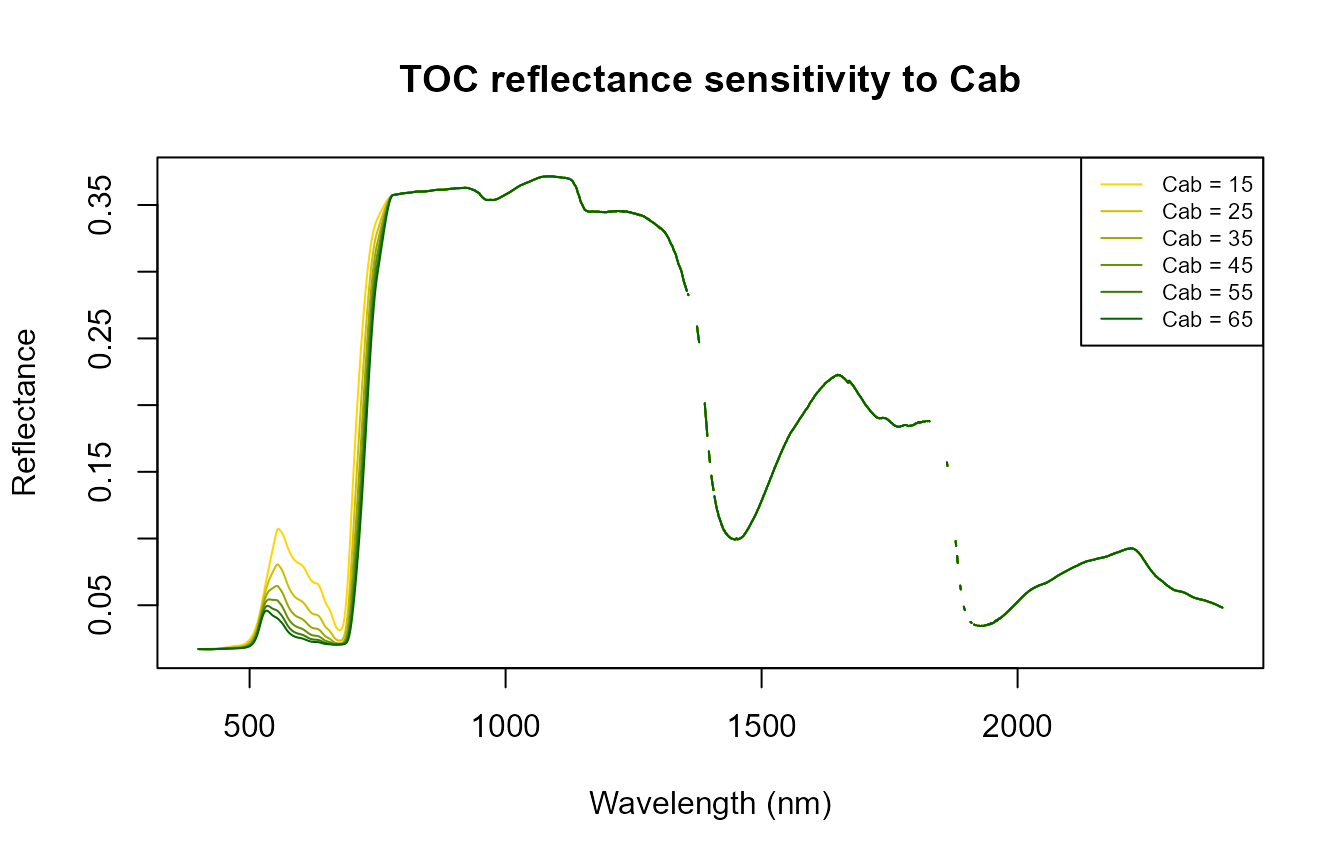
Chlorophyll’s own signature (red-edge/visible absorption) dominates – the expected, direct radiative-transfer effect.
2. Sweeping Vcmax25 (photosynthetic capacity)
Vcmax25 has no role in Fluspect/4SAIL’s radiative
transfer at all – any reflectance change it causes is entirely indirect,
through the energy balance:
vcmax_values <- seq(20, 200, length.out = 6)
res_vcmax <- lapply(vcmax_values, function(v) { row_i <- LUT_default[1, ]; row_i$Vcmax25 <- v; run_scope(row_i) })

Tcave_vals <- sapply(res_vcmax, function(r) r$data.fluxes$Tcave)
Actot_vals <- sapply(res_vcmax, function(r) r$data.fluxes$Actot)

op <- par(mfrow = c(1, 2))
plot(vcmax_values, Tcave_vals, type = "o", pch = 19, col = "#2166AC",
     xlab = "Vcmax25", ylab = "Canopy-average leaf temperature (degC)", main = "Tcave vs Vcmax25")
plot(vcmax_values, Actot_vals, type = "o", pch = 19, col = "#B2182B",
     xlab = "Vcmax25", ylab = "Actot (umol m-2 s-1)", main = "Actot vs Vcmax25")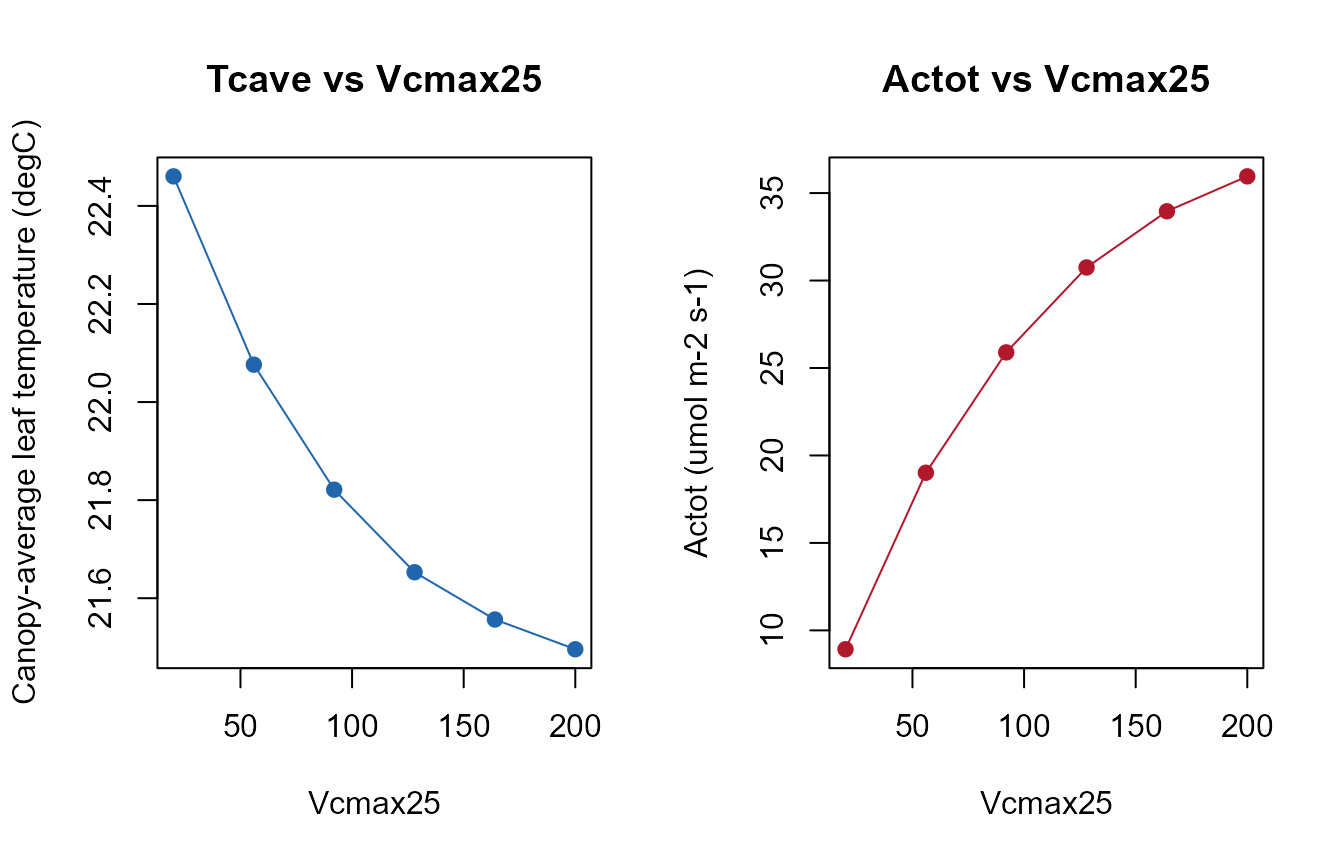
par(op)
cols2 <- colorRampPalette(c("gold", "darkblue"))(length(vcmax_values))
matplot(wl_optical, sapply(res_vcmax, function(r) r$data.rad$refl[1:n]), type = "l", lty = 1, col = cols2,
        xlab = "Wavelength (nm)", ylab = "Reflectance",
        main = "TOC reflectance sensitivity to Vcmax25 (indirect, via energy balance)")
legend("topright", paste("Vcmax25 =", round(vcmax_values)), col = cols2, lty = 1, cex = 0.7)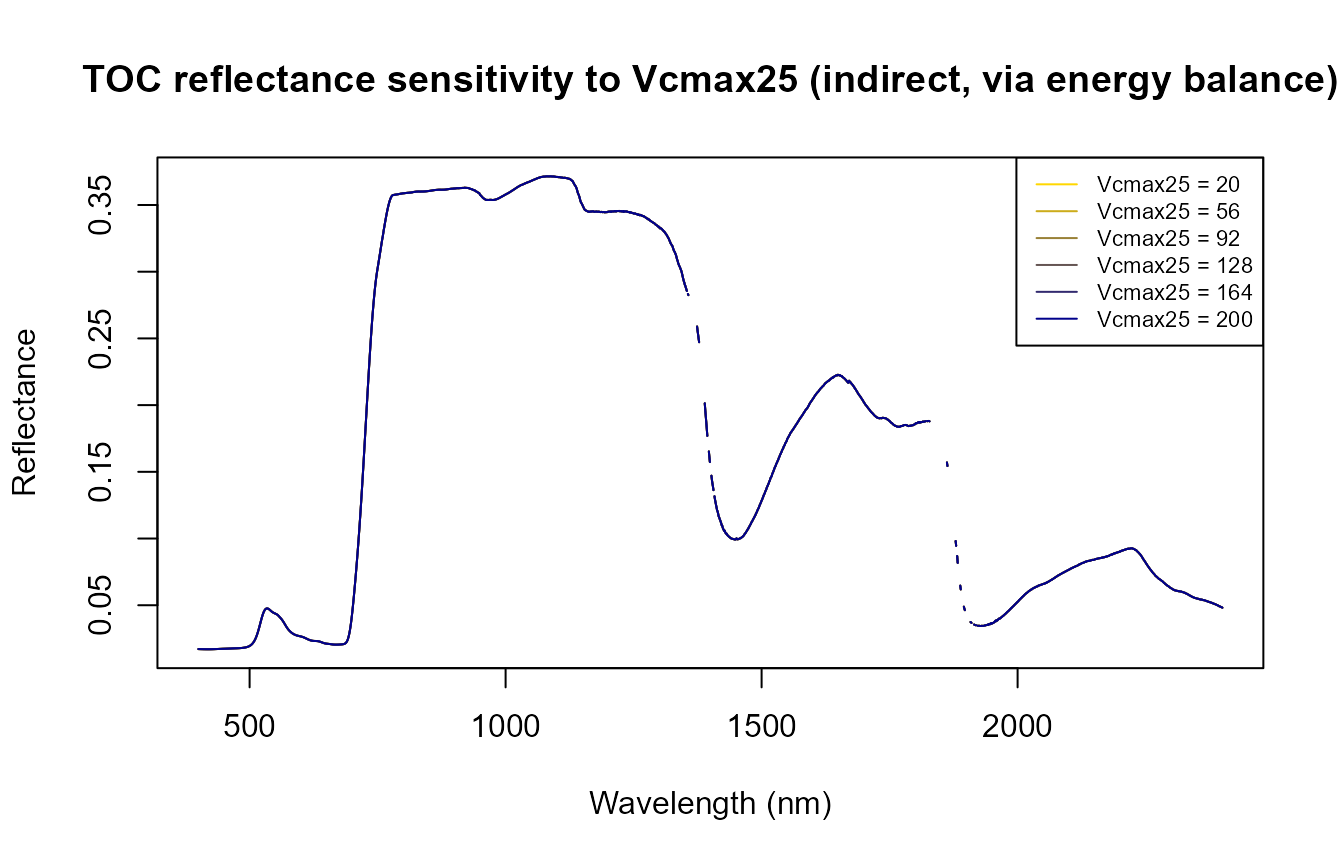
Actot responds strongly and directly to
Vcmax25, as expected from the Farquhar-type model. The
reflectance panel is the real point: any spread there is not
Fluspect/4SAIL reacting to Vcmax25 (it has no such input) –
it’s the small, indirect effect of a different leaf temperature feeding
into the thermal part of the spectrum. Compare its magnitude to the
Cab sweep above.
3. Sweeping LAI
lai_values <- seq(0.5, 6, length.out = 6)
res_lai <- lapply(lai_values, function(v) { row_i <- LUT_default[1, ]; row_i$LAI <- v; run_scope(row_i) })

cols3 <- colorRampPalette(c("gold", "darkred"))(length(lai_values))
matplot(wl_optical, sapply(res_lai, function(r) r$data.rad$refl[1:n]), type = "l", lty = 1, col = cols3,
        xlab = "Wavelength (nm)", ylab = "Reflectance", main = "TOC reflectance sensitivity to LAI")
legend("topright", paste("LAI =", round(lai_values, 1)), col = cols3, lty = 1, cex = 0.7)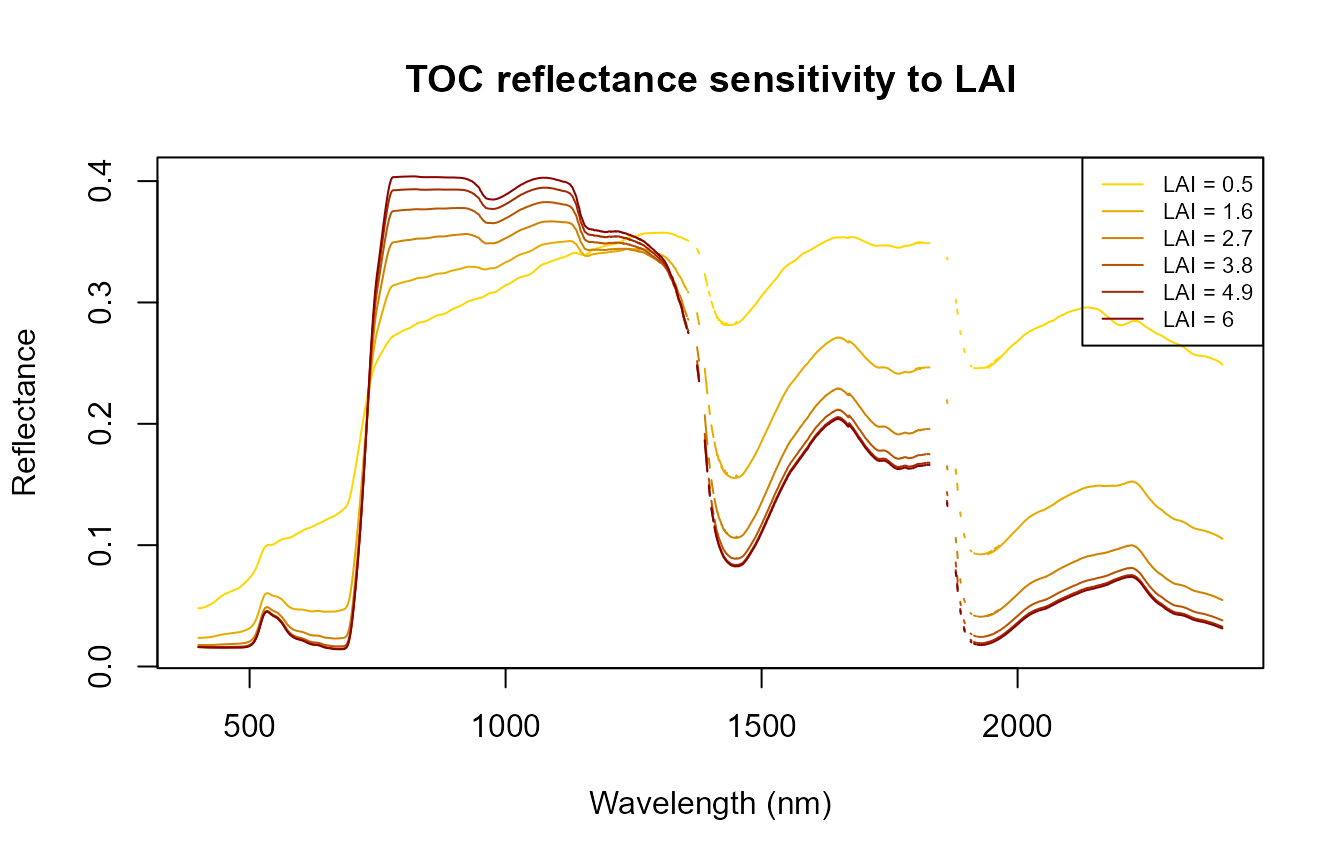
NIR reflectance rises with LAI to a plateau (more leaf layers scattering) – see ToolsRTM’s Tutorial 15 for how this same LAI-driven canopy closure also controls how much a soil trait can influence the signal.
Summary
| Trait swept | Direct RT effect? | Where it shows up |
|---|---|---|
Cab |
Yes – Fluspect input | Visible/red-edge reflectance, strong |
LAI |
Yes – 4SAIL input | NIR plateau height, strong |
Vcmax25 |
No – biochemistry only |
Actot strongly; reflectance only indirectly, via leaf
temperature |
This distinction is exactly what Tutorial 08 tests the practical
consequence of: can Vcmax25 actually be retrieved
from reflectance the way Cab/LAI can?