Trait inversion from SCOPE reflectance
inversion-scope.Rmd
library(ToolsRTM)
library(SCOPEinR)
library(randomForest)
The sensitivity-scope article on this site found that
Vcmax25 (photosynthetic capacity) has no direct
radiative-transfer signature – Fluspect/4SAIL don’t take it as an input
at all, so any reflectance response is indirect, through the leaf
temperature the energy balance solves for. This page tests the practical
consequence: can you actually retrieve Vcmax25 from
sensor-band reflectance, the way you can retrieve Cab or
LAI?
1. Simulate a LUT and convolve to Sentinel-2A
path_input <- system.file("input", package = "SCOPEinR")
scope_options <- read.table(file.path(path_input, "setoptions.csv"), header = TRUE, sep = ",")
inputLUT <- read.table(file.path(path_input, "inputs_SCOPE.csv"), header = TRUE, sep = ",")

n_samples <- 500
set.seed(11)
LUT <- getLUT.SCOPE(inputLUT = inputLUT, nLUT = n_samples)

db_sims <- get.SCOPE(LUT = LUT, n.LUT = n_samples, options.SCOPE = scope_options,
                      optipar = SCOPEinR::optipar2021.Pro.CX, leaf.model = "fluspect-CX",
                      canopy.model = "fourSAIL", get.outputs = "ALL", get.plots = FALSE)

wl_optical <- 400:2400
n <- length(wl_optical)

band_refl <- t(sapply(db_sims, function(r) {
  rfl_i <- r$data.rad$reflapp[1:n]
  # reflapp is a radiance ratio -- genuinely near-zero incident irradiance
  # at a handful of water-vapor/O2 absorption wavelengths makes it
  # numerically unstable there in every simulation (see How-in-R-SCOPEinR.Rmd,
  # Section 5). Linearly interpolate over those narrow gaps before convolving.
  bad <- !is.finite(rfl_i)
  if (any(bad)) rfl_i[bad] <- approx(wl_optical[!bad], rfl_i[!bad], xout = wl_optical[bad])$y
  df_i <- data.frame(wave = wl_optical, rfl = rfl_i)
  get.spectral.convolution.srf(df_i, ToolsRTM::srf.sentinel2a)$RFL
}))
colnames(band_refl) <- paste0("B", seq_len(ncol(band_refl)))
2. Train/test split, shared across all three traits
set.seed(1)
train_idx <- sample(seq_len(n_samples), size = round(0.7 * n_samples))
test_idx  <- setdiff(seq_len(n_samples), train_idx)

r2_f   <- function(obs, pred) 1 - sum((obs - pred)^2) / sum((obs - mean(obs))^2)
rmse_f <- function(obs, pred) sqrt(mean((obs - pred)^2))

invert_trait <- function(trait) {
  ml_data <- data.frame(band_refl, y = LUT[[trait]])
  rf <- randomForest(y ~ ., data = ml_data[train_idx, ], ntree = 300)
  pred <- predict(rf, ml_data[-train_idx, ])
  obs  <- ml_data$y[-train_idx]
  list(obs = obs, pred = pred, R2 = r2_f(obs, pred), RMSE = rmse_f(obs, pred))
}
3. Retrieve Cab, LAI, and
Vcmax25 – same method, same data
inv_cab    <- invert_trait("Cab")
inv_lai    <- invert_trait("LAI")
inv_vcmax  <- invert_trait("Vcmax25")
summary_df <- data.frame(
  trait = c("Cab", "LAI", "Vcmax25"),
  direct_RT_input = c("Yes (Fluspect)", "Yes (4SAIL)", "No (biochemistry only)"),
  R2   = c(inv_cab$R2, inv_lai$R2, inv_vcmax$R2),
  RMSE = c(inv_cab$RMSE, inv_lai$RMSE, inv_vcmax$RMSE)
)
knitr::kable(summary_df, digits = 3)| trait | direct_RT_input | R2 | RMSE |
|---|---|---|---|
| Cab | Yes (Fluspect) | 0.399 | 13.409 |
| LAI | Yes (4SAIL) | 0.706 | 1.069 |
| Vcmax25 | No (biochemistry only) | -0.073 | 68.891 |
op <- par(mfrow = c(1, 3))
plot(inv_cab$obs, inv_cab$pred, pch = 19, col = "#2E8B57",
     xlab = "Observed Cab", ylab = "Predicted", main = sprintf("Cab (R2=%.2f)", inv_cab$R2))
abline(0, 1, col = "grey40", lty = 2)
plot(inv_lai$obs, inv_lai$pred, pch = 19, col = "#2166AC",
     xlab = "Observed LAI", ylab = "Predicted", main = sprintf("LAI (R2=%.2f)", inv_lai$R2))
abline(0, 1, col = "grey40", lty = 2)
plot(inv_vcmax$obs, inv_vcmax$pred, pch = 19, col = "#B2182B",
     xlab = "Observed Vcmax25", ylab = "Predicted", main = sprintf("Vcmax25 (R2=%.2f)", inv_vcmax$R2))
abline(0, 1, col = "grey40", lty = 2)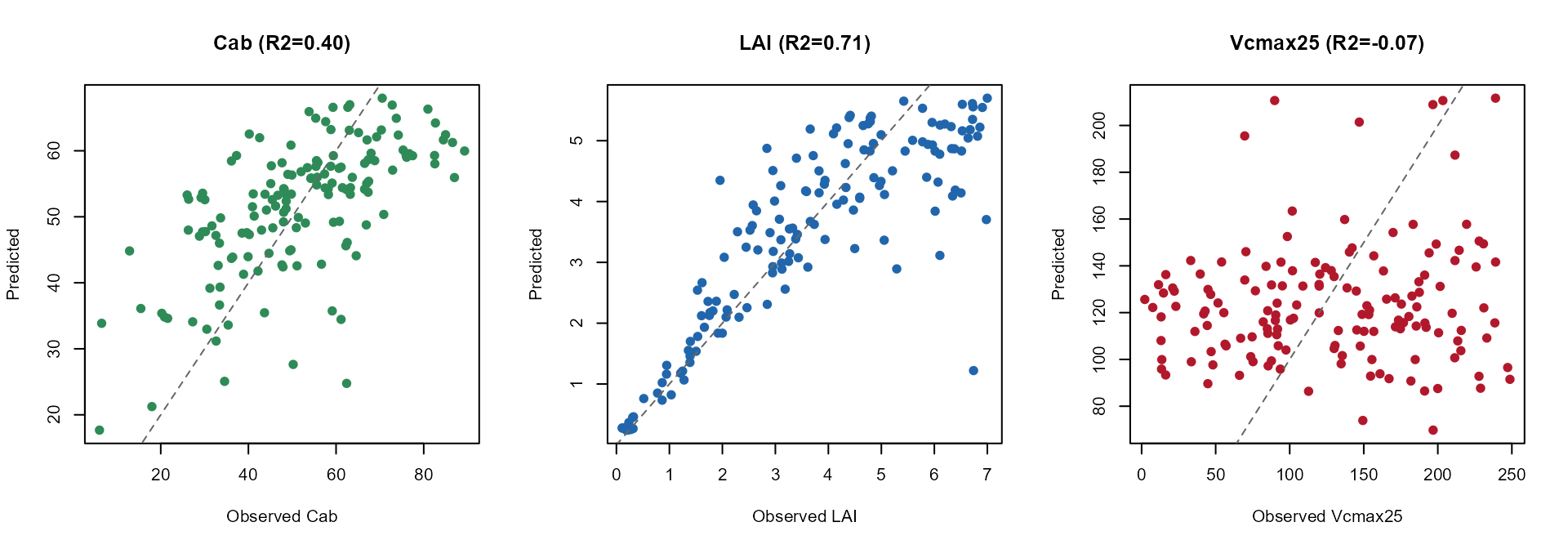
par(op)Vcmax25 comes back essentially unretrievable (R² below
zero – worse than just predicting the mean every time) even at
500 simulations: its only path into reflectance is the small,
indirect leaf-temperature effect the sensitivity-scope
article isolated, not a direct optical signature a 13-band sensor can
separate from everything else varying in this LUT at once. More training
data doesn’t fix this, because the problem isn’t sample size – it’s that
the signal genuinely isn’t there in reflectance to begin with. That’s
the expected result, not a failure of the method: SCOPE’s own coupling
of radiative transfer and biochemistry doesn’t imply every biochemical
trait becomes remotely retrievable just because it can be simulated.
LAI retrieves well (R² ~0.7) – its NIR-plateau signature
is strong enough to come through even with every other trait varying at
once. Cab retrieves moderately (R² ~0.4) – weaker than its
strong, direct role in Fluspect alone would suggest, because
getLUT.SCOPE() varies every free parameter simultaneously
(leaf biochemistry, LAI, leaf-angle distribution, geometry – see
getting-luts-scope), adding real confounding noise a
smaller, more targeted LUT wouldn’t have. Sample size does matter for
Cab specifically: this page’s 500-row LUT retrieves it
noticeably better than an earlier 80-row version of this same experiment
did (R² 0.23 there vs. 0.40 here) – unlike Vcmax25,
Cab has a real signal to find, just one more training data
helps Random Forest separate from the LUT’s other simultaneous nuisance
variation.
See How-in-R-SCOPEinR.Rmd (Section 5) for the same
LAI-retrieval pattern at N=100 walked through step by step, and the
ToolsRTM package’s InversionOpt article for
the LUT merit-function-matching alternative to Random Forest (applied
there to plain PROSAIL rather than full SCOPE).