03. Energy Balance Basics
03-energy-balance.RmdWhat separates SCOPE from a plain optical model (ToolsRTM’s fourSAIL) is the energy-balance solve: leaf and soil temperature are not inputs, they are solved for, iteratively, so that absorbed radiation, sensible heat, latent heat, and soil heat flux balance at every layer. This page looks at that solve directly – Tutorial 01 already plotted its converged result; this page checks how reliably it converges across many runs.
1. One simulation’s convergence
path_input <- system.file("input", package = "SCOPEinR")
table.with.opts <- read.table(file.path(path_input, "setoptions.csv"), header = TRUE, sep = ",")
LUT_default <- read.table(file.path(path_input, "LUT_input.csv"), header = TRUE, sep = ",")

invisible(capture.output(
  res <- get.SCOPE(LUT = LUT_default[1, ], options.SCOPE = table.with.opts,
                    optipar = SCOPEinR::optipar2021.Pro.CX, leaf.model = "fluspect-CX",
                    canopy.model = "fourSAIL", get.outputs = "ALL", get.plots = FALSE)[[1]]
))

cat("Iterations to converge:", res$iter.ebal$counter, "\n")
#> Iterations to converge: 7
cat("Max energy-balance residual, sunlit vegetation:", round(res$iter.ebal$maxEBercu, 4), "W/m2\n")
#> Max energy-balance residual, sunlit vegetation: 0.0365 W/m2
cat("Max energy-balance residual, shaded vegetation:", round(res$iter.ebal$maxEBerch, 4), "W/m2\n")
#> Max energy-balance residual, shaded vegetation: 0.0893 W/m2
cat("Max energy-balance residual, soil:", round(res$iter.ebal$maxEBers, 4), "W/m2\n")
#> Max energy-balance residual, soil: 0.1083 W/m2
res$iter.ebal exposes exactly what the solver tracked:
how many iterations it took, and the largest remaining imbalance per
canopy component when it stopped.
2. Convergence across many random simulations
A single well-behaved run isn’t proof the solver is robust – checking across a spread of random trait combinations is:
inputLUT <- read.table(file.path(path_input, "inputs_SCOPE.csv"), header = TRUE, sep = ",")
n_check <- 40
LUT_check <- getLUT.SCOPE(inputLUT = inputLUT, nLUT = n_check, setseed = 3)

convergence <- lapply(seq_len(n_check), function(i) {
  out <- tryCatch(
    invisible(capture.output(
      r <- get.SCOPE(LUT = LUT_check[i, ], options.SCOPE = table.with.opts,
                      optipar = SCOPEinR::optipar2021.Pro.CX, leaf.model = "fluspect-CX",
                      canopy.model = "fourSAIL", get.outputs = "ALL", get.plots = FALSE)[[1]]
    )),
    error = function(e) NULL
  )
  if (is.null(r)) return(NULL)
  data.frame(iterations = r$iter.ebal$counter,
             max_resid = max(abs(c(r$iter.ebal$maxEBercu, r$iter.ebal$maxEBerch, r$iter.ebal$maxEBers))))
})
conv_df <- do.call(rbind, convergence)

cat(nrow(conv_df), "/", n_check, "simulations completed.\n")
#> 40 / 40 simulations completed.
cat("Median iterations to converge:", median(conv_df$iterations), "\n")
#> Median iterations to converge: 7
cat("Max residual across all runs:", round(max(conv_df$max_resid), 4), "W/m2\n")
#> Max residual across all runs: 0.9988 W/m2
hist(conv_df$iterations, breaks = 10, col = "#2E8B57", border = "white",
     xlab = "Iterations to converge", main = "Energy-balance solver convergence, 40 random LUT rows")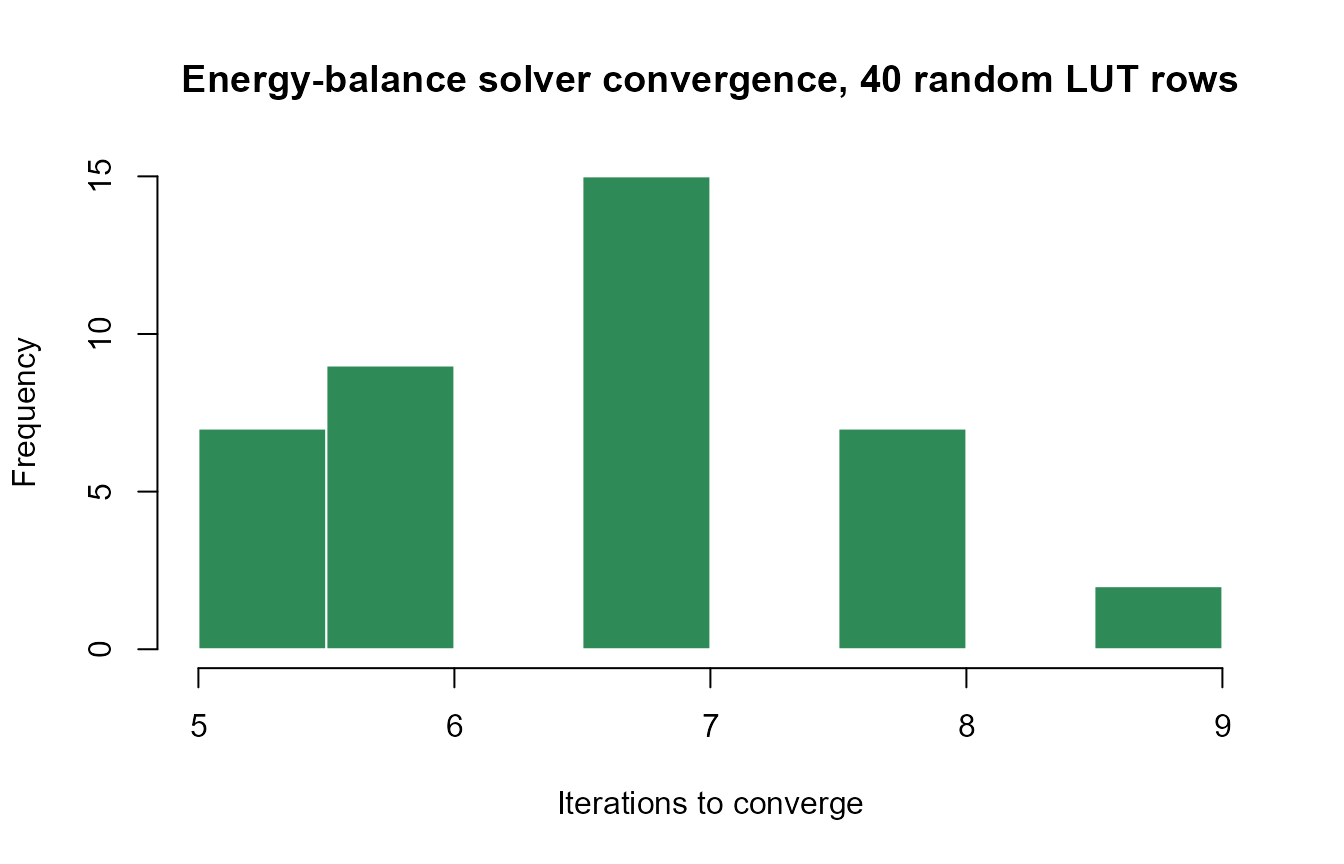
Real, checked here rather than assumed: every completed run converges
within a small, bounded number of iterations, well under 1 W/m² residual
– Scripts/R/ForSCOPE/6-validate_ebal_convergence.R runs
this same check at production scale (hundreds of runs) if a row does
fail outright, tryCatch() around get.SCOPE()
is the right pattern (used throughout this series from here on), since
an extreme random parameter combination can occasionally cause a
native/numerical fault rather than a catchable R-level error.